

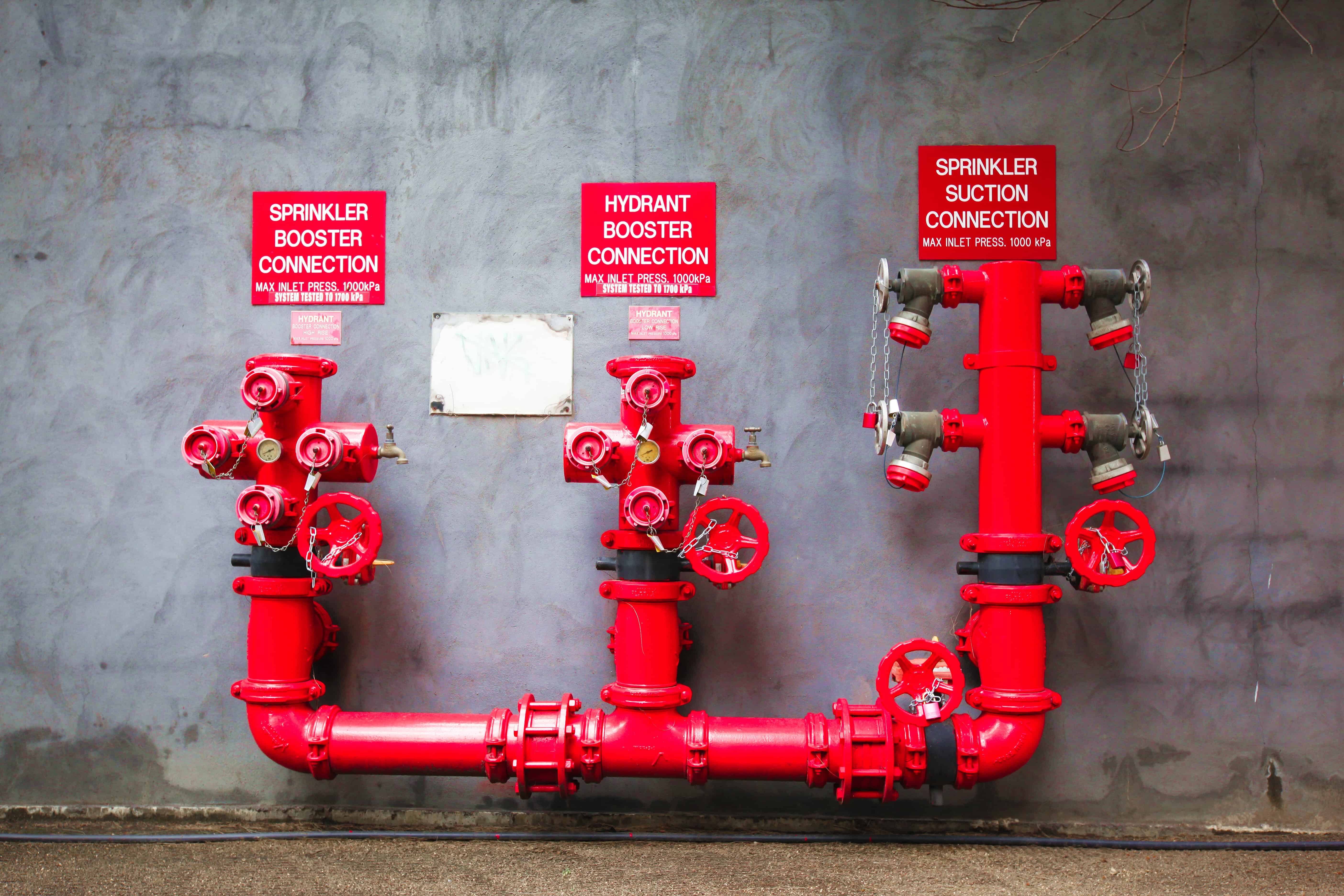
MEPCO Group provides comprehensive fire fighting systems designed to protect life and property with unmatched reliability and efficiency. Our extensive range of solutions includes:
- Sprinkler Systems
- Hose Reels Systems
- Landing Valves Systems
- Deluge Systems
- Foam Systems
- FM 200 Systems
- Hydrant Systems
- Fire Pumps & Controls
- Piping for Sprinklers Systems
Sprinkler Systems
A fire sprinkler system is an active fire protection method that consists of a water supply system, providing adequate pressure and flowrate to a water distribution piping system connected to fire sprinklers. Upright and pendent sprinklers produce a hemispherical water distribution pattern below the deflector. During a fire, the thermal-sensitive liquid in the glass bulb expands, causing the bulb to shatter, releasing the button and spring seal assembly.
Hose Reels Systems
A fire hose is a high-pressure hose that carries water or fire retardant (such as foam) to extinguish fires. Outdoors, it connects to a fire engine or hydrant, while indoors, it can permanently attach to a building's standpipe or plumbing system. A hose reel is a cylindrical spindle made of metal, fiberglass, or plastic, used for storing a hose. The most common styles are spring-driven (self-retracting), hand crank, or motor-driven.
Landing Valves Systems
A firefighting landing valve is a crucial part of the hose system, acting as a manual stop valve for controlling the firefighting system. By rotating the landing valve handle anti-clockwise, water flow in the firefighting system is activated.
Deluge Systems
A deluge fire sprinkler system is similar to a pre-action system, except the sprinkler heads are open and the pipe is not pressurized with air. Deluge systems are used in high hazard areas such as power plants, aircraft hangars, and chemical storage or processing facilities.
Foam Systems
A compressed air foam system (CAFS) delivers fire retardant foam for firefighting, extinguishing fires, or protecting unburned areas. The foam blankets the fuel, reducing its capacity to seek out an oxygen source.
FM 200 Systems
FM200 is a synthetic fire suppression gas that extinguishes fires by removing the free radicals or heat elements from the fire triangle (oxygen, heat, and fuel). FM200 is stored as a liquid in pressurized cylinders and flows through a piping network to a discharge nozzle where it is deployed as a gas. FM200 systems are designed to discharge within 10 seconds into a room or enclosure with structural integrity to retain the agent, uniformly mixing to achieve a minimum concentration level in accordance with NFPA 2001 or agency listings.
Hydrant Systems
A fire hydrant is a visible fixture connected to a municipal or private water service network, designed to provide the water required by firefighters to extinguish fires. Fire hydrants are placed inside or outside buildings, parking areas, industrial areas, mines, roadsides, etc.
Fire Pumps & Controls
A fire pump is a component of a fire sprinkler system's water supply, powered by electricity, diesel, or steam. The pump intake is connected to the public underground water supply piping or a static water source (e.g., tank, reservoir). Fire pumps are usually housed in a pump room near the fire tanks and are controlled by pressure sensors. When a hydrant is opened or a sprinkler is activated, the pressure drops, and the sensors detect this drop, switching the fire pumps on.
Piping for Sprinkler Systems
Firefighting pipes are carbon steel pipes used to convey fire suppression agents such as water or gas. Typically red, light-wall pipes may have a galvanized exterior. Red steel pipes are limited to wet pipe sprinkler systems only. The most commonly used steel pipe for sprinkler systems is black steel pipe. Copper tubing is also listed for sprinklers in NFPA 13, and plastic pipes (CPVC and PEX tubing) are permitted for certain sprinkler systems.
Have a Project in Mind?
Talk to our team about your requirements and get a tailored solution.